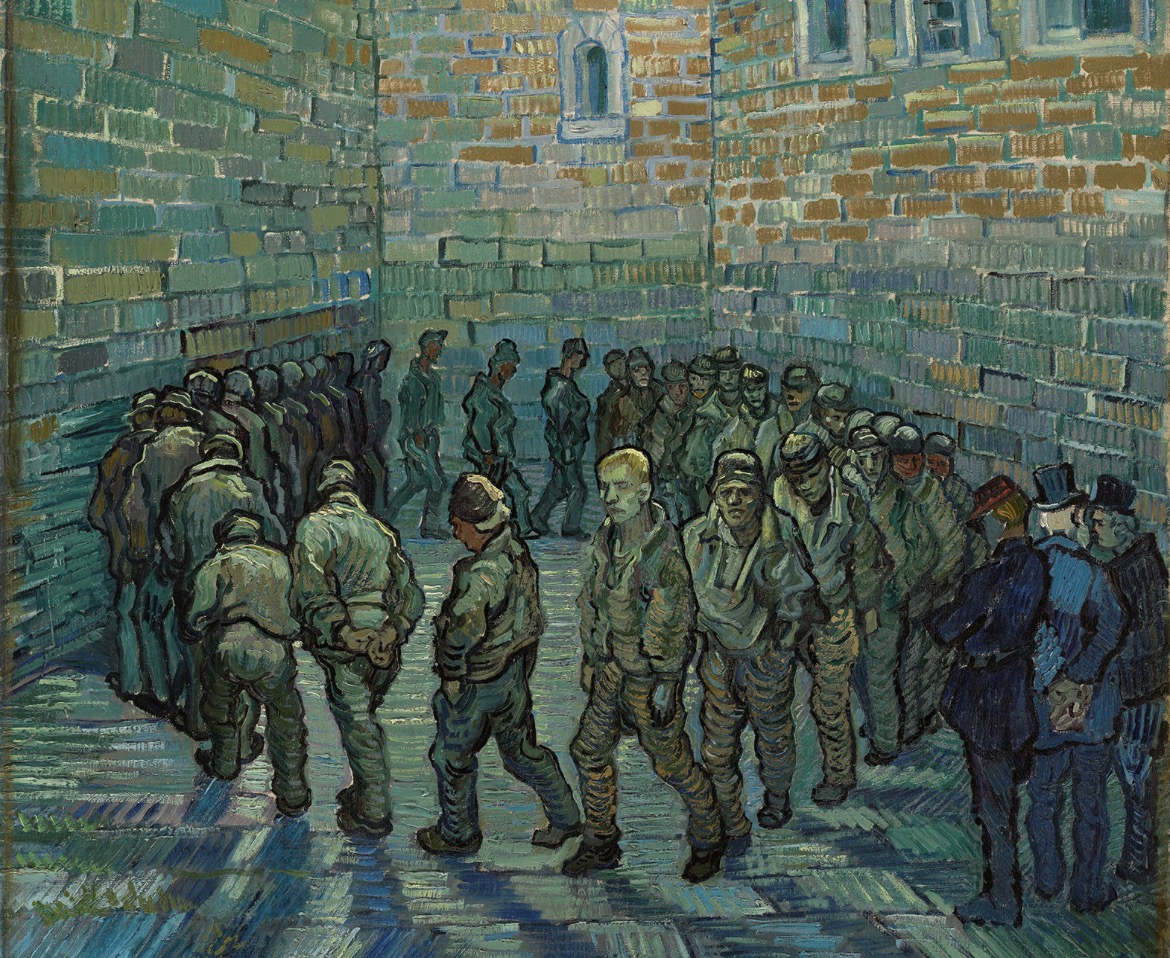
I. The Guilty Mind
The legal system, for all its failures, got one thing philosophically right: behavior alone does not determine culpability. What matters — what has always mattered in any serious moral framework — is the interior state that precedes the act.
Mens rea. The guilty mind. Or in its absence, the innocent one.
Criminal and tort law developed an entire taxonomy for this. Premeditation. Knowledge. Recklessness. Negligence. These aren't just legal categories — they're a formal acknowledgment that the same external act carries entirely different moral weight depending on what was happening inside the person who committed it. The law, at its philosophical foundation, is an intentionality system.
And then it built an inferential apparatus to work backwards from behavior to mind. Premeditation is inferred from evidence of planning. Impulse is inferred from its absence. The interior is always the target. Behavior is just the trail of evidence pointing toward it.
Here is where autistic neurology introduces a problem the law never anticipated, and moral philosophy hasn't adequately addressed:
What happens when the inferential chain breaks?
When an autistic person carries full premeditation — genuine, sustained, sometimes elaborate intention — and still produces the behavioral signature of negligence?
II. The Uncontested Will
To understand why this happens, we need to briefly descend into the architecture.
Autistic neurology does not have a reliable pipeline between intention and execution. This isn't metaphor. The basal ganglia — the subcortical structure responsible for initiating and sequencing voluntary action — shows atypical dopaminergic signaling in autistic brains. The D2 receptor asymmetry that governs reward anticipation and action initiation means that even strongly held intentions frequently fail to generate the neurochemical cascade that would normally translate them into behavior.
Add to this monotropism — the tendency for autistic attention to flow deeply into a single channel, leaving other channels effectively offline — and you have a system where intention can exist fully formed in one part of the mind while remaining completely inaccessible to the part responsible for acting on it.
This is not akrasia. Aristotle's problem of akrasia — acting against your better judgment — assumes a competing desire that wins. There is a war, and the wrong side takes it. But autistic execution failure is not a war. There is no competing desire. The intention is uncontested. The will is not divided. It simply does not fire.
Philosophy does not yet have clean language for this. An uncontested will that produces no action. A mind that is fully oriented toward something it cannot reach.
Harry Frankfurt, in his landmark essay on freedom of the will, distinguished between first-order desires — wanting something — and second-order volitions — wanting to want something, endorsing a desire as your own. His argument was that what makes us morally responsible agents is the alignment between these levels. You are free when what you do reflects what you genuinely will yourself to do.
By Frankfurt's framework, many autistic people are operating with perfect second-order alignment. The will is clean. The endorsement is genuine. And the first-order mechanism still doesn't fire.
That is a philosophical problem that Frankfurt's framework doesn't resolve. And it is the daily lived reality of a significant portion of the human population.
III. The Believing Gap
So we have established that intention is the morally relevant variable, that the legal system knows this, and that autistic neurology systematically disrupts the behavioral evidence that would normally make intention legible to others.
This is where the problem stops being neurological and becomes social.
Miranda Fricker, in Epistemic Injustice, identified a specific form of harm she called testimonial injustice — the wrong done to someone when they are not believed, when their credibility is deflated not because of anything they actually said or did, but because of who they are perceived to be. The listener brings a prejudice to the testimony that discounts it before it lands.
Autistic people experience a structural version of this in the domain of intention.
When behavior is the only legible proof of interior state — when "I meant to" is evaluated exclusively against "but did you" — autistic people are systematically excluded from being believed. Not because they are lying. Not because their intentions are absent or corrupt. But because the behavioral currency that testimony about intention is supposed to be backed by is unreliable in their case.
The neurotypical accountability framework is, at its core, a behavioral verification system. It extends trust provisionally and then requires behavioral confirmation to sustain it. Show me, over time, that your intentions are real by acting on them consistently. This is not an unreasonable system for a neurotypical population. But applied universally, it functions as a structural exclusion mechanism for anyone whose execution is neurologically compromised.
The autistic person who genuinely meant to follow through, who planned, who cared, who intended fully — and still didn't — has no recourse within this framework. The behavior speaks. The intention has no other voice.
What fills that gap is trust. And trust, unlike behavioral verification, requires something the system rarely offers autistic people: the willingness to grant credibility to an interior state you cannot directly observe.
This is not a request for lowered standards. It is a request for the correct standards. The ones the legal system already acknowledged when it made mens rea the hinge of moral culpability. The ones moral philosophy has always gestured toward when it insisted that what matters is not just what you do, but what you meant.
The problem is that meaning something, for autistic people, is sometimes the only thing they have access to.
And the world has not yet learned to receive that as enough.
IV. Guilt Is Actionable. Shame Is Structural.
The external problem is hard enough. But the internal one is where it gets brutal.
Because autistic people do not only face the judgment of others. They face their own.
And here is the paradox: you have direct access to your intentionality in a way no one else does. You know what you meant. You know the quality of your care. You know whether the failure was moral or mechanical. In that sense, you are the most qualified person in the room to evaluate your own accountability.
And yet.
The measuring stick you are holding is not yours.
The standards by which most autistic people judge themselves were built by and for a neurotypical majority, transmitted through every institution, relationship, and cultural message absorbed from childhood. Be consistent. Follow through. Do what you say you will do. Show up. These are not presented as ideals calibrated to a particular neurological architecture. They are presented as the basic minimum of being a trustworthy person.
So the autistic person sits in the gap between their genuine intention and their inconsistent execution, applying a standard that was never designed for their nervous system, and concludes: I am failing at being a person.
Not failing at a task. Failing at personhood.
This is where shame lives. Not guilt — guilt says I did something wrong. Shame says I am something wrong. Guilt is actionable. Shame is structural. And when the gap between intention and execution is neurological rather than moral, guilt is actually the wrong response — but shame moves in anyway, because the framework says the failure is yours.
What autistic self-accountability requires is something precise: the ability to distinguish between moral failure and functional unreliability as separate axes that do not determine each other.
You can be morally intact and functionally unreliable simultaneously. These are not the same dimension. A person can mean everything they say and still not be able to deliver it consistently. A person can be deeply trustworthy in their orientation toward others and still miss deadlines, forget responses, abandon plans mid-execution — not from carelessness but from a nervous system that does not complete the circuit.
Conflating these two axes is not humility. It is a category error. And it is one that autistic people are trained to make about themselves from the time they are old enough to be told they are disappointing someone.
The work of autistic self-accountability is not lowering your standards. It is learning to apply the right standards to the right dimension. To hold yourself fully responsible for the quality of your intention, the honesty of your communication, the genuine orientation of your care — and to hold your execution with something closer to what you would offer a body managing a chronic condition. Not excuse. Not dismissal. Accurate understanding of what the body can and cannot reliably do.
It requires, in the end, becoming the most reliable witness to yourself that you have.
V. A Boy of Seventeen
Consider a boy of seventeen.
He is bright, intense, loyal to a degree that most people will never experience from another human being. He has one best friend — the kind of best friend that autistic people form bonds with, which is to say: completely. Totally. The friendship is not casual. It is load-bearing. It is one of the primary structures his world is organized around.
He also has a girlfriend. And he loves her the way seventeen-year-old boys love — which is already a lot — filtered through a nervous system that does not do anything at half-measure.
One day he finds out that these two people, the two people who together constitute most of his emotional world, have been sleeping together behind his back.
What happens next will be described in court documents as an assault.
What actually happened was this: every attachment his nervous system had organized itself around was severed simultaneously. The betrayal did not land the way it would land for a neurotypical boy — as pain, then grief, then rage, in sequence, with small gaps between them where choice could theoretically live. It landed all at once, at a magnitude that had no ceiling, processed by a brain with no adequate braking system. Rejection sensitive dysphoria — a feature of ADHD neurology that most of the adults in his life had never heard of, because most of them had never needed to — produces emotional responses that arrive faster than thought. Faster than decision. Faster than the part of the brain that weighs consequences and says: wait.
He did not decide to fight his best friend.
He was already fighting him by the time anything resembling a decision was available.
This is not an excuse. It is a description. And the difference between those two things is precisely what was never examined in the courtroom.
No one in that courtroom knew he was autistic. He didn't know. His parents didn't know. His teachers, who had watched him struggle and hyperfocus and melt down and recover his whole life, had never once used that word. He fit the profile completely — the presentation clinicians were already documenting in autistic boys, the intense interests, the deep loyalties, the social navigation that worked until it catastrophically didn't, the nervous system running ten times hotter than anyone could see from the outside.
No one looked for it. So no one found it.
What they found instead was a boy who had committed an act of violence and could not adequately explain himself. Who sat in that courtroom and could not produce the affect that might have humanized him — the visible remorse, the appropriate eye contact, the emotional legibility that neurotypical jurors read as evidence of conscience. Who may have appeared flat when he was shattered, or intense when he was trying to be calm, because his nervous system has never reliably translated internal state into readable external signal.
They gave him five years. Maximum security. At seventeen.
And then they put him in isolation.
The reasoning was administrative, clinical in its indifference: he was considered dangerous. A threat to the population. A boy whose nervous system had blown apart under the weight of the most devastating betrayal he had ever experienced was now classified, processed, and filed under that single word.
Dangerous.
What isolation does to a neurotypical person is well documented. Sensory deprivation. Psychological deterioration. The slow erasure of the self that happens when human contact — the thing we are built for — is systematically removed. The United Nations has called prolonged solitary confinement torture. The research is unambiguous.
What isolation does to an autistic person is something the research is only beginning to catch up to. Consider what you are doing when you place an autistic nervous system in solitary confinement.
You are removing the few external structures that help regulate a system that cannot fully regulate itself. You are eliminating the sensory input that an autistic nervous system needs in specific forms to stay coherent — not the random, unpredictable sensory chaos of a prison population, but rhythm, pattern, predictability, something to organize around. You are taking a person whose inner world is already vast, already loud, already running without adequate filters — and locking him inside it with no exit.
You are removing the possibility of the one thing that might have helped: another human being who could see him.
He had no diagnosis. He had no language. He had no framework for understanding what was happening to him neurologically, which meant he had no way to communicate it, no way to ask for what he needed, no way to explain to anyone — including himself — why the isolation was not just punishment but something closer to erasure.
A neurotypical person in isolation loses contact with the world.
An undiagnosed autistic person in isolation loses contact with himself.
Because the self, for many autistic people, is not a stable internal object that persists regardless of environment. It is something constructed and maintained in relationship — to structure, to pattern, to the few trusted people whose presence makes the world legible. Remove all of that, and what remains is not a person resting in their own company.
What remains is a nervous system in freefall, with no one watching, and no words for what is happening.
This is what the system called appropriate management of a dangerous individual.
Now consider what was never entered into evidence.
That the fight lasted minutes and the friendship had lasted years.
That in the entire history of his seventeen years, there was no pattern of violence — because violence was never who he was, it was what happened once, in a moment of neurological crisis that no one had ever equipped him to understand or survive.
That the friend who pressed charges had betrayed him in the most total way available — had reached into the two relationships that structured his world and dismantled both of them simultaneously — and that an autistic nervous system experiences that kind of betrayal not as an event but as a catastrophic loss of structural reality.
That he sat in that courtroom unable to perform remorse in a legible way — not because he felt none, but because his face and his body have never reliably broadcast what his interior contains. That the jury watched him and saw flatness where there was devastation. Coldness where there was shock. Danger where there was a boy who was already destroyed before they added five years on top of it.
That no one asked: what kind of mind are we actually judging here?
That no one was equipped to ask.
The system that failed to see him when he was a child — that never named what he was, never gave him tools, never intervened when his neurology was doing what undiagnosed, unsupported neurology does — then punished him for the consequences of that failure as though he had chosen it.
Forty-eight years later, someone finally gave him the diagnosis.
Forty-eight years of living in a body and a mind he had no accurate map for. Forty-eight years of measuring himself against a standard built for a different nervous system entirely, and finding himself wanting, without ever knowing why the gap was always there, without ever understanding that the gap was not a moral failing but a structural fact.
He had to understand, at whatever age forty-eight years after seventeen leaves you, that the system didn't fail to see him because he was invisible.
It failed to see him because it never learned to look.
VI. The Tensions
What happened to that boy was not an anomaly. It was the logical output of a system applying the wrong framework to the wrong subject — consistently, confidently, and without any mechanism for recognizing its own error.
To understand why, we need to examine every point at which the accountability framework fractures when applied to neurodivergent minds. Not to dissolve accountability. But to locate it accurately.
I. The Impulse and the Will
The law distinguishes premeditated action from impulsive action. It already knows these are different moral events. What it has not yet fully reckoned with is that impulsive action in a neurotypical person and impulsive action in an ADHD nervous system are not the same phenomenon.
For a neurotypical person, impulse control is a capacity that exists and can be exercised with varying degrees of success. The inhibitory mechanism is present. It can be overwhelmed — by rage, by fear, by substances — but its absence in a given moment is situational, not structural.
For a person with ADHD, the inhibitory mechanism itself is compromised at the neurological level. The prefrontal cortex — the structure responsible for braking, for consequence-processing, for the gap between impulse and action where choice theoretically lives — is underactivated and underconnected. This is not a character description. It is a neuroanatomical fact.
Which means the question the law needs to ask is not: did this person have impulse control and fail to use it?
The question is: was impulse control available to this person at this moment, in this nervous system, under this magnitude of emotional load?
Those are not the same question. And the answer to the second one changes everything about culpability.
II. The Voluntariness Spectrum
Legal and moral philosophy tend to treat action as either voluntary or involuntary. You chose it, or something outside your control produced it. But this binary has always been philosophically unstable — and neurodivergence exposes exactly where it breaks.
Impulsive action in an ADHD nervous system is neither fully voluntary nor fully involuntary. It is something in between that our frameworks don't have clean language for. The person was present. They were conscious. There was no external compulsion. But the internal architecture that would have allowed deliberation — that would have created the gap between stimulus and response where a choice could occur — was not available.
Aristotle called truly voluntary action that which originates from within and where the person knows what they are doing. By that standard, impulsive action under neurological crisis is at best partially voluntary. The origination is internal. But the knowing — the full consequential awareness that genuine voluntariness requires — was structurally foreclosed before it could operate.
Partial voluntariness should produce partial culpability. The law has mechanisms for this — mitigation, diminished capacity, degrees of intent. What it lacks is consistent application of those mechanisms to neurodivergent defendants, because it first requires someone in the room who understands what they are looking at.
III. The Working Memory Problem
Accountability assumes memory. It assumes you knew the rule, retained the agreement, held the consequence in mind, and acted anyway. The entire moral logic of responsibility is built on the premise that the relevant information was available to you when you made your choice.
ADHD working memory deficits mean that information which was genuinely known — sincerely agreed to, fully intended — may not be available at the moment of action. Not because the person is lying about having known it. Not because they didn't care. But because working memory is the cognitive system that holds active information in mind across time, and that system is compromised.
You cannot hold someone fully accountable for failing to act on information their brain could not reliably retain.
This does not mean agreements are meaningless for ADHD people. It means that accountability frameworks need to account for the support structures required to make those agreements operable. When those structures are absent, and failure results, the question of who bears responsibility for the absence of support is at least as important as the question of who failed to follow through.
IV. Time Blindness and Temporal Accountability
The legal system runs on time. Statutes of limitations. Deadlines. The assumption that consequences delivered after the fact will modify future behavior because the person can connect the present moment to the past act and the future outcome in a coherent temporal chain.
ADHD time blindness — the neurological phenomenon in which time is experienced not as a continuous flow but as two states, now and not now — disrupts this logic at every level.
Consequences that arrive after the moment of action may not connect, neurologically, to that action in the way punishment theory assumes. The deterrence model presupposes a mind that can project itself forward, feel the future consequence as real and proximate, and allow that feeling to inhibit present behavior. A brain that experiences everything outside the immediate present as equally abstract cannot do this reliably.
This means the entire punitive logic of the legal system — the assumption that punishment teaches, that consequence deters, that five years will produce a person less likely to act impulsively next time — fails on its own terms when applied to ADHD neurology.
You cannot deter a nervous system from doing something it didn't decide to do.
V. Emotional Dysregulation and the Magnitude Problem
Standard accountability frameworks assume a roughly proportionate relationship between provocation and response. The law makes room for crimes of passion — it already knows that extreme emotional states produce different moral events than calm deliberation. But it calibrates that room for neurotypical emotional experience.
ADHD and autism both produce emotional responses that are disproportionate by neurotypical standards — not because the person is dramatic or manipulative, but because the neurological systems that modulate emotional intensity are structurally different. Rejection sensitive dysphoria alone can produce an emotional response to perceived rejection that is, by clinical description, among the most intense experiences a human nervous system can generate. It arrives in milliseconds. It does not wait for context. It floods the system before any cognitive appraisal is possible.
The law has no category for this. Crimes of passion exist on a spectrum the law recognizes. But crimes of neurological crisis — where the passion itself is structurally amplified beyond what the architecture can contain — exist in a space the law has not yet mapped.
VI. The Consistency Problem
One of the most insidious features of neurodivergent accountability is the inconsistency of symptoms — and what that inconsistency looks like to observers.
Autistic and ADHD people are not impaired in every domain at every moment. They have good days and bad days, regulated states and dysregulated ones, contexts that support function and contexts that undermine it. This variability is a feature of the condition, not evidence that the condition isn't real.
But to a neurotypical observer — a judge, a juror, an employer, a partner — inconsistency looks like choice. If you could do it last Tuesday, you could do it this Tuesday. If you managed to control yourself in one situation, you could have managed it in another. The visible capability becomes proof of universal capability, and the failure becomes proof of willful negligence.
The variability that is intrinsic to their neurology is used as evidence against them. The moments of successful function are weaponized to delegitimize the moments of failure.
VII. Self-Advocacy Under Pressure
Courtrooms are designed, intentionally or not, to produce the worst possible conditions for autistic and ADHD performance.
High sensory stimulation. Rigid procedural demands. Sustained attention required across unpredictable time. Extreme social stakes producing extreme social anxiety. The requirement to produce affect on demand — visible remorse, appropriate gravity, legible humanity — in front of strangers who are actively judging you.
These are precisely the conditions under which autistic masking collapses, ADHD attention fragments, and the internal experience of the defendant becomes most completely invisible behind a surface that reads, to neurotypical observers, as evasive, cold, unstable, or dangerous.
The defendant who needs most urgently to be seen clearly is rendered most completely illegible by the conditions of the very process designed to see him.
And his failure to explain himself becomes evidence against him.
VIII. The Peer Problem
A jury of peers is supposed to be a safeguard. The logic is that people who share your social reality are better positioned to evaluate your choices within it.
But peer has always meant something shallower than it should. It has meant community member. Fellow citizen. Adult of sound mind. It has never meant: someone who knows from the inside what it is to have this nervous system.
And that is the only peer who could actually evaluate what happened in that courtroom accurately. Not someone who can imagine what a devastating betrayal feels like. Someone who knows what it feels like when the nervous system has no ceiling for that feeling and no brake between the feeling and the body.
Without that peer in the room, the evaluation is not inaccurate because the jurors are malicious. It is inaccurate because they are working from a map of human interiority that does not include the territory they are being asked to navigate.
They are judging a country they have never visited, using a guidebook written entirely by people who have never been there either.
IX. What Justice Actually Requires
None of this is an argument for the abolition of accountability.
Accountability matters. The harm done to the friend was real. The fear, the injury, the rupture — these are not dissolved by neurological explanation. The person harmed deserved acknowledgment and recourse.
But justice requires accurate understanding of what it is judging. It requires the capacity to ask not just what happened, but what kind of event this was — what mental state produced it, what neurological architecture shaped that mental state, what supports were absent that might have changed the outcome, what the punishment can realistically achieve given the actual mechanism that produced the act.
A system that cannot ask those questions is not dispensing justice. It is dispensing the appearance of justice — the procedural forms of accountability without the philosophical substance.
VII. The Invisible Population
He is not alone.
He was never alone. He simply had no way of knowing that, sitting in isolation, in a maximum security prison, at seventeen years old, with no diagnosis and no language and no map.
The cells around him — in that prison, in every prison — were full of people the system had similarly misread. Not identically. But structurally the same. People whose neurology placed them outside the framework's imagination, and who were punished for that distance as though they had chosen it.
Consider the numbers.
Somewhere between a quarter and forty percent of incarcerated people in the United States have a traumatic brain injury. Not a metaphor. Not a behavioral description. A physical injury to the organ responsible for judgment, impulse control, emotional regulation, consequence processing, and the capacity to form and execute intention. The same organ the legal system presupposes to be intact when it asks: what did you mean to do?
ADHD appears in the general population at rates of roughly five to ten percent. In prison populations, estimates range from twenty-five to forty percent. The condition most characterized by impaired impulse control, compromised working memory, time blindness, and the inability to reliably connect present action to future consequence — is massively overrepresented in the population we have decided to punish most severely for exactly those deficits.
Autism is similarly overrepresented, though harder to count precisely because so many autistic people, like that boy, arrive at incarceration without a diagnosis. They enter the system invisible and leave it the same way.
And then there are the people with brain tumors. With early onset dementia. With untreated psychosis. With fetal alcohol spectrum disorder, which alters the architecture of judgment and impulse at the developmental level before the person has drawn their first breath outside the womb. With severe depression that flattens volition to near zero. With PTSD that hijacks the threat-response system so completely that violence becomes reflexive, automatic, a survival mechanism firing in contexts where survival is not actually at stake but the nervous system cannot tell the difference.
Every single one of these people processed through a framework that asks: what did you intend? And answers that question by reading behavior as though behavior were a transparent window into a standard human mind.
It is not. It has never been.
The legal system is not unaware that brains differ. It has mechanisms — diminished capacity, the insanity defense, competency evaluations, mitigating circumstances — that were built precisely to account for the fact that the organ of judgment is not always functioning within normal parameters.
What it lacks is the capacity to apply those mechanisms accurately and consistently to the full range of neurological difference that actually exists in the population standing before it.
The insanity defense, in most jurisdictions, requires that the defendant did not know what they were doing, or did not know it was wrong. This is an extraordinarily narrow standard. It was designed for florid psychosis. It does not reach the vast middle territory where a person knows, abstractly, that what they are doing is wrong — but cannot stop. Cannot hold the knowledge in mind long enough for it to operate. Cannot feel the future consequence as real. Cannot locate the braking mechanism that would allow the knowledge to translate into restraint.
That middle territory is where most neurodivergent and neurologically injured defendants actually live.
And the law drives straight past it.
There is a word for what happens when a system consistently applies the wrong standard to a population and consistently produces unjust outcomes as a result, without ever examining the standard itself.
The word is not mistake.
Mistakes are corrected when they are identified. A system that has access to the neuroscientific literature, that has been presented with the data on ADHD and autism and traumatic brain injury in prison populations, that has watched the research accumulate for decades — and has not fundamentally revised its framework — is not making mistakes.
It is making choices.
It is choosing to define the standard human mind in a way that excludes a significant portion of the human population. It is choosing to interpret that exclusion as individual moral failure rather than systemic philosophical error. It is choosing to punish the neurological outlier for their distance from the norm rather than examining whether the norm was ever an adequate basis for justice.
And it is choosing, every day, to fill its cells with the people that choice produces.
VIII. What We Owe the Unread Mind
This essay does not end with answers.
It was never going to. The questions it raises are not the kind that resolve cleanly — not because the thinking hasn't gone far enough, but because the problems are real and the solutions require something our institutions have not yet demonstrated the capacity to provide.
What it ends with instead is an accounting. A laying out of what we know, what we have chosen not to act on, and what that choice costs.
We know that intention is the morally relevant variable. The legal system encoded this understanding centuries ago and built an entire philosophical architecture around it. We know that the same act carries different moral weight depending on what was happening inside the person who committed it. We know that behavior is evidence of interior state, not identical to it.
We know that neurological difference disrupts the inferential chain between interior state and observable behavior. We know that a significant portion of the people currently incarcerated have brains that were never adequately accounted for by the framework that put them there. We know that these conditions were, in most cases, undiagnosed at the time of the offense.
We know all of this.
The question is not whether we know it.
The question is what knowing obligates us to do.
At minimum, it obligates us to ask different questions.
Not just: what did you do?
But: what kind of mind was present when you did it? What was that mind capable of in that moment? What did it have access to? What was structurally unavailable to it? What supports were absent that might have changed the outcome? What can punishment realistically achieve given the actual mechanism that produced the act?
It obligates us to build those questions into the framework — not as exceptional accommodations granted in rare cases to defendants lucky enough to have the right advocate in the room, but as standard features of a justice process serious about the philosophical commitments it claims to hold.
It obligates us to train the people who populate that process — judges, jurors, public defenders, prosecutors, court psychologists — in the neuroscience that is already available, already documented, already sitting in the literature waiting to be used.
It obligates us, in the daily texture of life outside the courtroom, to extend the same rigor to the smaller accountabilities — the relationships, the workplaces, the families, the friendships where neurodivergent people are held to standards built for minds they don't have, and found wanting, and handed shame for the distance.
For the neurodivergent person reading this:
The framework was wrong. Not you.
The measuring stick was built for a different nervous system and handed to you without explanation, and you have been measuring yourself against it your whole life and finding the gap and calling the gap a moral failing. It is not. It was never a moral failing. It was a category error — one that was made about you before you had the language to contest it.
Your intention is real. Your care is real. Your moral seriousness — the part of you that genuinely wants to do right, that genuinely orients itself toward others, that genuinely grieves when the execution fails — is real, and it is yours, and it belongs to you regardless of what the behavior managed to prove on any given day.
You are not the gap.
You are what exists on the other side of it.
For everyone else:
The next time you are in the position of judging a neurodivergent person — in a courtroom, in a relationship, in a workplace, in a family — before you reach for the standard framework, before you measure the gap between what they said they would do and what they did, before you conclude that the gap is evidence of character:
Ask what you actually know about the mind you are judging.
Ask whether the standard you are applying was built for that mind.
Ask whether you are evaluating intention or behavior — and whether you have been honest with yourself about the difference.
And if the answer to any of those questions is no — consider what justice actually requires before you proceed.
We built the concept of mens rea because we understood, at some fundamental level, that the mind matters. That what happens inside a person is morally relevant. That we cannot do justice to someone without first doing the harder work of seeing them accurately.
We have not yet extended that understanding far enough.
We have not yet learned to see the minds that don't announce themselves in neurotypical language. The ones that intend fully and execute inconsistently. The ones that feel everything and show nothing. The ones that knew what they were doing was wrong and could not stop because stopping requires a mechanism that wasn't there.
When we do — when the framework catches up to the neuroscience, when the courtroom catches up to the research, when the people doing the judging are equipped to see what they are actually looking at — justice will look different than it does now.
It will be slower. More complicated. Less satisfying in its clean procedural finality. And it will be more true.
That boy deserved more true.
Every person sitting in a cell right now whose neurology was never accurately accounted for deserves more true.
The work of getting there begins where all philosophical and moral progress begins:
With the willingness to look at what we thought we knew and ask whether we actually knew it.
With the willingness to see the mind we failed to see the first time.
With the willingness, finally, to read the unread.